
There is no universal “perfect policy pack”
Organisations often search for a definitive list of policies required by ISO 27001. The standard does require certain documented information, and controls may create additional documentation needs, but the most effective policy set is shaped by the organisation’s scope, risk treatment choices and operating model. A small cloud business and a multi-site enterprise can both conform to ISO 27001 while needing different levels of documentation.
The purpose of a policy is to state required behaviour clearly enough that people can act consistently and management can assess compliance. Creating a separate policy for every possible topic can make the system harder to maintain, while putting everything into one enormous information security policy can make obligations difficult to find.
The goal is not to maximise the number of policies. It is to make responsibilities and required behaviour clear, governed and demonstrably implemented.
Let controls and operational responsibility shape the structure
Common policy areas include access control, acceptable use, information classification, supplier security, incident management, backup, cryptography, secure development, business continuity and personnel security. Whether these are separate policies, standards or sections within broader documents should depend on who needs to use them and how frequently they change.
A useful design principle is to separate durable governance rules from fast-changing operational detail. The board-level expectation that privileged access must be tightly controlled may remain stable, while the procedure for configuring a particular identity platform may change frequently. Treating these as different document types keeps approval proportionate.
Policy quality is demonstrated through use, not length
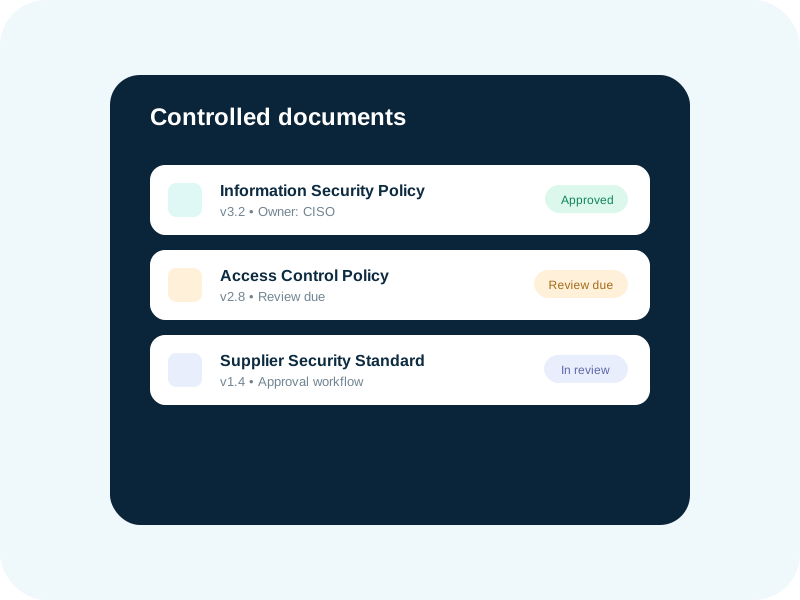
A policy becomes meaningful when it has a clear owner, appropriate approval, controlled versions, a review cycle and evidence that the requirement is actually followed. An auditor is unlikely to be impressed by fifty beautifully formatted policies if staff do not know which version applies or operational evidence contradicts them.
The strongest policy environment therefore connects documents to the controls, risks, owners and evidence they support. That makes policy governance part of the living ISMS rather than a document library sitting beside it.
Make this easier to manage in OrcaComply
OrcaComply keeps the decisions, owners, documents, controls and evidence behind your ISMS connected so the work is easier to manage and easier to explain.
Explore document governance →